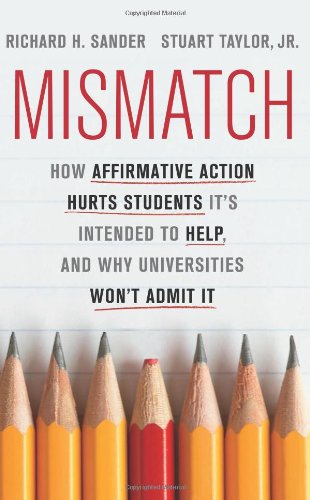
Mismatch: How Affirmative Action Hurts Students It's Intended to Help, and Why Universities Won't Admit It
| Müəllif | Richard Sander, Stuart Taylor Jr. |
|---|---|
| Nəşr olunduğu il | 2012 |
| Elm sahəsi | Elm və təhsil |
| Nəşriyyat | Basic Books |
| Nəşr yeri | New York |
Richard Sander, Stuart Taylor Jr.. Mismatch: How Affirmative Action Hurts Students It's Intended to Help, and Why Universities Won't Admit It. New York, Basic Books, 2012.
The debate over affirmative action has raged for over four decades, with little give on either side. Most agree that it began as noble effort to jump-start racial integration; many believe it devolved into a patently unfair system of quotas and concealment. Now, with the Supreme Court set to rule on a case that could sharply curtail the use of racial preferences in American universities, law professor Richard Sander and legal journalist Stuart Taylor offer a definitive account of what affirmative action has become, showing that while the objective is laudable, the effects have been anything but.
Sander and Taylor have long admired affirmative action's original goals, but after many years of studying racial preferences, they have reached a controversial but undeniable that preferences hurt underrepresented minorities far more than they help them. At the heart of affirmative action's failure is a simple phenomenon called mismatch. Using dramatic new data and numerous interviews with affected former students and university officials of color, the authors show how racial preferences often put students in competition with far better-prepared classmates, dooming many to fall so far behind that they can never catch up. Mismatch largely explains why, even though black applicants are more likely to enter college than whites with similar backgrounds, they are far less likely to finish; why there are so few black and Hispanic professionals with science and engineering degrees and doctorates; why black law graduates fail bar exams at four times the rate of whites; and why universities accept relatively affluent minorities over working class and poor people of all races.